What A Meal Actually Does
Eat a plate of food with carbohydrate in it and glucose arrives in your bloodstream over the following hour or two. How high that arrival peaks, and how long it stays up, is what people mean when they talk about a post-meal curve. Two people can eat the same plate and produce very different curves.
What happens next is a question of demand. Glucose in the blood has to go somewhere, and the largest customer for it, by a wide margin, is skeletal muscle.
Why Walking Works So Well
Contracting muscle takes glucose out of the bloodstream through a route that does not require insulin to open the door. The transporter involved, GLUT4, moves to the cell surface in response to contraction itself. That is a genuinely useful piece of biology: it means movement lowers circulating glucose through a mechanism that runs in parallel to the hormonal one rather than depending on it.
The practical consequence is that a walk taken while glucose is arriving does more than the same walk taken four hours later. Timing is most of the effect.
How Long, And When
| Timing | What it does |
|---|---|
| Within 15 minutes of finishing | The best window. Glucose is arriving and the muscle is ready to spend it |
| 10 minutes | Enough to matter. This is the whole point — the bar is low |
| 30 minutes | Better, if you have it. The returns are real but not proportional |
| Two hours later | Still good for you. Much less relevant to that particular meal |
Pace barely matters. This is not exercise in the sense of training; it is demand created at the right moment. Walking to the end of the road and back qualifies.
The version that survives. Pick the meal you are least likely to be rushing away from — for most people that is dinner — and attach the walk to it permanently. A habit tied to an existing event outlasts a habit tied to a time of day.
Where A Supplement Fits Around This
It fits around it, not instead of it. A blend like GlycoAid is formulated to support blood sugar already in a healthy range, and it does that alongside how you eat and move rather than in place of either. Anyone selling a capsule as a replacement for a ten minute walk is selling something they should not be.
The two ingredients in the formula that act at the same moment as the walk are White Mulberry Leaf and Cinnamon Bark, both of which work on carbohydrate as it is being broken down in the gut. Same window, different mechanism.
The Honest Limits
- It does not undo a meal. A large plate of refined carbohydrate followed by a walk is still a large plate of refined carbohydrate.
- It is not a treatment for anything. Anyone managing a diagnosis takes their direction from their own clinician.
- The effect is on that meal. It is not a deposit against next Tuesday.
What it is, is free, immediate, and better supported than most of what gets marketed at people worrying about their numbers.
Questions
Questions On This Article
How long should the walk be?
Ten minutes is enough to matter, which is the entire point. Thirty is better if you have it, but the ten minute version is the one people actually keep doing.
Does it have to be brisk?
No. The mechanism is muscle contraction taking glucose up, and ordinary walking pace provides that. This is not a training session.
Before or after the meal?
After, and within about fifteen minutes of finishing. The point is to be moving while glucose is arriving.
Can I do something else instead?
Anything that contracts large muscles works on the same principle. Washing up, gardening, climbing stairs. Walking is simply the easiest to repeat every day.
Next
More From The Journal
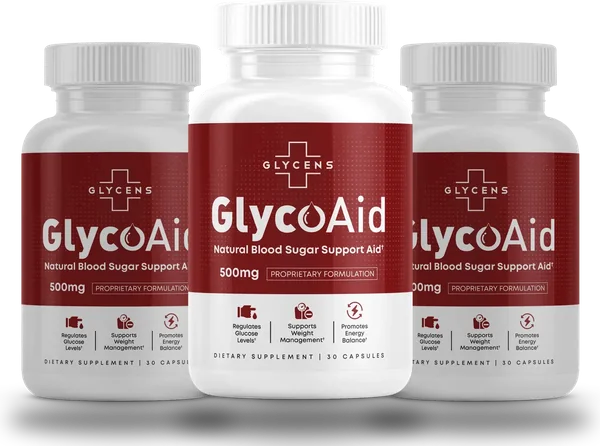
Start Your First Bottle Of GlycoAid
One capsule with a meal, a page here for every name on the label, and two months to send it back if it does nothing for you.
- One capsule a day, taken with food
- Fourteen ingredients, all named on the panel
- Free US delivery on the 3 and 6 bottle packs
- Sixty days to return it, opened bottles included